
Does a Building Need to Breathe?

If you’ve been around the industry for a hot second or for decades, you’ve heard people talking about buildings needing to “breathe.” It comes up a lot on renovations of older buildings in particular.
If I had a nickel for every old timer who told me “these old houses are still standing because they breathe! It’s good for houses to leak. Modern houses are too tight, and that’s what causes problems!” I’d be able to quit my job. And then they regale me with stories about houses they’ve seen that were “just fine” for hundreds of years, til some whippersnapper came in there and “tightened everything up.”
The thing is, they’re not really wrong, but…not for the reasons they’re thinking.
By the way, I love “old timers” and have learned so much from them, I’m starting to sound like one myself sometimes…!
So back to breathing. Does a building need to breathe?
Yep, it sure does. But….
It doesn’t need to *leak*…and that’s the difference.
Think about humans. We need to breathe, or we’ll die. But we don’t breathe *randomly,* we breathe through a very specific set of mechanisms and systems. We breathe through our mouth and nose, where air can be filtered, and where we can control if air comes in at all [closing our mouths, holding our noses]. We have a bellows system [our lungs] which controls the volume and frequency of air entering our bodies. We have a circulation system for distributing oxygen, and an exchange system for transferring oxygen to the blood cells that need it.
While air is passing through these filters and systems, we’re getting information about our environment, as well - smells, tastes, humidity, etc all tell us something as we breathe the air.
We also “breathe” through our skin, which is a pretty amazing mechanism for filtration, protection, and transfer. But like a fish can’t process oxygen unless it’s passing over their gills via water, we can’t process the oxygen we need through our skin - we need to breathe it in gaseous form, through our nose and mouth.
So, hopefully you can see where I’m going with this. Buildings are the same as humans, in many ways. They need to exchange air in the same way a body does - in a controlled way.
Random leaky walls are not only ineffective, they’re also dangerous, as they bring airborne stuff into the building through mechanisms and assemblies that aren’t meant to filter air, and/or come into contact with air.
This can mean anything from mere discomfort to serious danger for the integrity of the building.
Think about sitting next to a drafty window in winter…it’s very uncomfortable! Humans are very sensitive to drafts and temperature change, and even a minor draft can make a space unbearable. One of my favorite books on the topic:

Let’s also remember what’s really happening here, thermodynamically. While people usually say “the cold air is blowing in from the outside,” what’s actually happening is the opposite - warmer inside air is flowing to the exterior - because heat always moves from hot to cold [thank you, entropy].
Of course, if there is a wind outside, or a pressure differential, the air might be moving differently. But it’s important to generally remember that hot moves to cold.
Ok, so a draft by a window is merely uncomfortable…not ideal but not causing a ton of damage to the building. Let’s return to that same dynamic in the summer time, when in many places in the US, it’s quite humid. Now, through that gap at the window, hot, moist air is moving from outside to inside [because hot moves to cold, and presumably you’ve got the AC on], and when that hot, moist air hits the colder surfaces inside the wall, it condenses.
Now I have running water inside my wall. It’s not going to “dry out” unless I can change the laws of physics.
Why did old houses not have this problem? Bingo….no AC, and often no insulation, so the temperature differential was not as great, or even present at all.
And, in case you wondered just how much water can be brought in by a tiny hole in a wall, take a gander at this diagram:
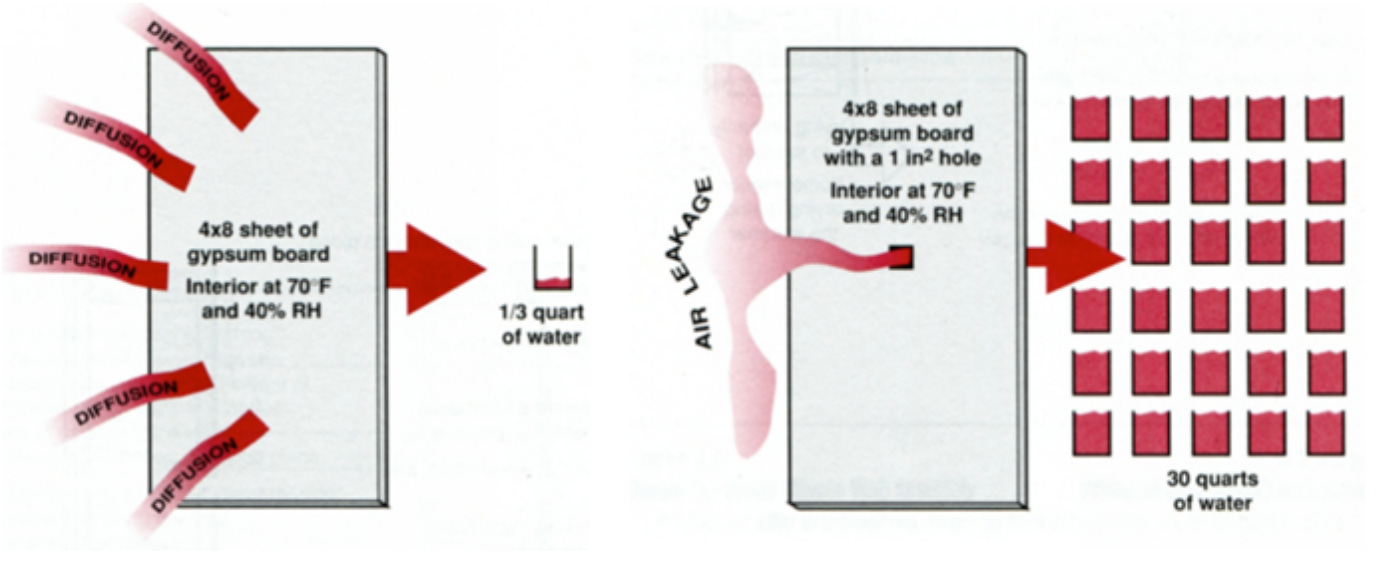
A 1”x1” hole in a 4’x8’ sheet of drywall lets 30 QUARTS of water pass through in the same time it takes 1/3 of a quart to pass through the wall by diffusion/difference in pressure.
This tells us we need to seal up the building. Pronto. Every air leak is bringing in water in prodigious quantities, especially in humid zones.
But once we seal up the building, we need to ventilate with intention: dedicated fresh air intakes that go to a filtration system, careful use of windows for natural ventilation, etc.
We also need to watch out for putting the house in negative pressurization, which encourages more air/water to come pouring through the walls. See, what happens is, if you build a tight house, and put in a huge kitchen exhaust and a bunch of bath fans, you’re constantly pumping air out of the house. So, like a balloon that’s slightly deflated, the atmospheric pressure around the house will drive more air/moisture into the house.
We counteract that by making sure we have a properly sized fresh air intake, that’s - in a controlled manner - bringing in more CFM [cubic feet per minute] of air than what we’re exhausting with the kitchen and bath fans. When the house is very tight, we can’t rely on the incidental opening and closing of doors. Like a human, the building needs to be breathing all the time.
So I’m going to wrap it up here, because I’m standing at the edge of a series of serious rabbit holes here - for those that don’t know, I’ve been a college professor for many years, teaching building science and related topics, and each of these paragraphs above could be a whole lecture [or three] in my classes.
My goal here was to explain the basic concepts without going to deep into the science…we can save that for other newsletters. And of course, please let me know if you have comments or questions below!
Meanwhile, if you’re interested in learning more about how this stuff works, there is *a lot* of good info out there - and a lot of bad stuff too [so be careful]! Here are two of my favorite resources:
Building Science Corporation - tons of amazing white papers that are easy to understand and very practical. I recommend the seminars and books as well.
Building Science Fight Club - treasure trove of IG posts on lots of great topics, as well as courses.
And reminder: this is a high level review of some complicated subjects. If you’re trying to tackle these things in a current project, make sure you’re consulting with professionals…and not relying on the HVAC sub and his 30 year old “ductulator” chart.
Thank you for reading! As always, if you’re finding value here, please consider sharing with someone who might be interested:
Oh man I've had this conversation with clients and builders SO many times. Love the lungs analogy, definitely using that next time. And the air sealing diagram by Lstiburek. Thanks. :)