
Building Codes: Start Here
I-Codes and ADA and local amendments, oh my!

As you may have seen, I’ve recently launched an architectural consulting service! Bring my brain into your project for a quick consult, a second opinion, or to help you make decisions about your project. More info here!
Everyone's favorite killjoy - building code! Codes are in place to protect occupants of buildings, and like contracts, are all about how to get into one, be safe once you're inside, and get out in case of emergency.
It is said that every line of code is in place because of an actual tragedy that officials are trying to prevent from happening again.
While it may not exactly be true of "every" line of code, horrific incidents like the 1911 Triangle Shirtwaist Fire in New York City's Greenwich Village did have a large impact on the development of modern building codes. When the factory caught fire, 146 workers died, unable to escape because the exits and doors to the stairs were locked from the outside [to prevent workers from taking unauthorized breaks].

Following the fire, NYC passed many new laws and ordinances regarding exits, stairs, doors, locking mechanisms, presence of fire extinguishers, and the like, to prevent such an event from ever happening again - and many of our modern codes have their origins in these measures.
"Building Code" isn't a singular monolith - it's actually a collection of books and codes that stretch into the many thousands of pages. It is administered by each state, so each state has different codes - the logic here is that what's appropriate for California [like seismic stuff] is not really much of an issue for Maine, and stuff that concerns Maine [snow, cold] really isn't an issue for Florida.
That's also why architects - who are responsible for following code with their designs - are licensed by state, not federally. They need to understand the local conditions where they're working.
So let’s dig further in…
At the state level, a "model code" is usually adopted - often, the International Building Codes, or "I-Codes," which is then adapted with amendments by each state. Then, in some states, each local municipality has the opportunity to add amendments, changes, and/or special provisions.
In Massachusetts, for example, the state has adopted the I-Codes, but with a giant book of amendments and changes - all collected under 780 Code of Massachusetts Regulations [CMR]. Every so many years, the state adopts a new code, with new amendments, and everyone in the building industry has to learn the new codes. New I-Codes are published every 3 years, though not every jurisdiction adopts them that fast.
So let's say you'd like to know what stair rise/run you can use in a single family home. First, you'd look it up in the IRC book [International Residential Code, the I-Code that applies to 1-2 family houses], and you'd see that it allows a 10" tread and a 7-3/4" rise.
Ok, great, now you can plan your stair - or - no - you have to look up the same section in the MA Amendments. There, you'll see an amendment allowing you to decrease the tread to 9" and increase the rise to 8-1/4". This is a huge help when trying to fit stairs into tight spots, and if you didn't look at the amendments, you'd miss out on this helpful nugget.
This process must be repeated for every line of code, every element in the building, across the entire building. By the end of the three year cycle, many folks have a lot of these provisions memorized, but at the beginning of the cycle or in the transition between cycles - like where we are right now in Massachusetts - you have to look everything up, in case they changed it.
In some states, there's another layer of code regulation - say, for New York City or Philadelphia, for example, which have their own modifications to the state codes.
The I-Codes consist of many volumes. The first fork in the road is whether you're under International Building Code [IBC] or International Residential Code [IRC]. IBC governs everything other than 1-2 family homes and some other out-building/shed structures. It's often called "commercial code," but that's a misnomer, as a lot of residential projects are also governed by IBC - all multifamily, large single family, anything mixed use, and many adaptive reuse projects.
The other volumes of the I-Codes include Electrical, Mechanical, Fire, Plumbing, Energy Conservation, Existing Buildings, etc - here’s the full list:
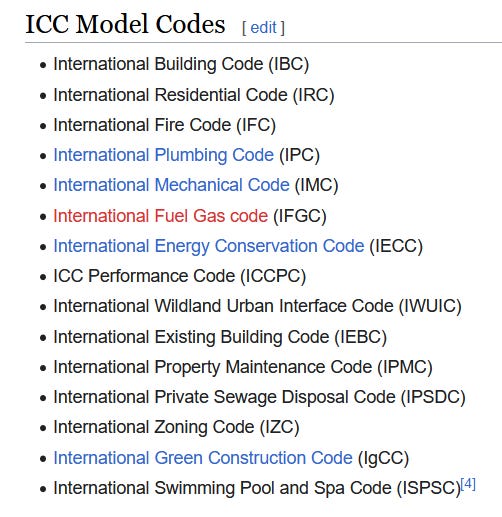
These codes are written to reference each other and build on each other, but you still need to understand which version of each of these your state has adopted, and which your state hasn’t adopted at all [which means you can ignore them].
One of the trickiest is the International Existing Buildings Code, which governs, you guessed it, renovations and alterations to existing buildings. Because the situation in every existing building is different, the code can’t address every single circumstance, leaving a lot up for interpretation. This is where a lot of negotiating with local officials comes in, and where you need to build a really solid case for how you’d like to proceed through the code. That’s what a good architect does for you!
You may be wondering - how have we gotten this far without discussing one of the most impactful sets of building regulations - ADA, or, the Americans with Disabilities Act. Well, that’s because it’s not part of the I-Codes, but is federal legislation, administered by the Justice Department, and enacted in 1991.
Wait, isn’t building code administered by each state? How does federal legislation fit into that?
Well, it depends on the state! In Massachusetts, there is a whole separate regulation and oversight board that tackles accessibility, under MA 521 CMR. If you look at 521, you’ll see that it looks mysteriously identical to ADA - because in many cases, the MA Architectural Access Board adopted ADA word for word. But not everything! So you have to keep your eyes out, and really know the code.
Other states accept ADA without changes, and some states write their own version, which then has to be approved by the Justice Department.
And just a reminder - ADA isn’t just about “wheelchairs” - it’s about addressing many forms of disability, from hearing and vision impairment to cognitive impairment to mobility issues.
Finally, one more fun part of code…the “AHJ” [authority having jurisdiction, aka your local building official] has a lot of power. Many sections of code say something like “guardrails must be xyz, unless otherwise required by the AHJ.” That means that your local code official can say just about whatever they want, and you’ll have to follow it. Believe me when I’ve seen this play out in some amazingly frustrating ways for our clients…and it’s a good reminder to be friendly, helpful, clear, and non-confrontational when dealing with building departments…you don’t want those guys irritated with you!
Oh - and we haven’t even gotten to the various regulations like the Fair Housing Act or other legislation and ordinances that impact capital-A Affordable housing specifically…that’s gotta be a whole ‘nother post!
In conclusion…
Code is not straightforward, by a longshot. Like other laws, it requires interpretation, especially when there are conflicts or contradictions in code. A classic one is the conflict between a historic building [governed by IEBC] and ADA - when do we have to bring a historic building fully “up to code,” and when can we leave historic [but not code compliant] elements in place? This is often a negotiation with local code officials, and you’re going to want serious professionals in your corner for that one.
We’ve had a lot of success as architects over the years with helping clients get creative within the code, finding ways to help them achieve their goals while also keeping code officials happy - and that takes legwork, creativity, and deep knowledge of the process. Don’t rely on a fly-by-night code interpretation, it could cost you *a lot* of money and time!
Even seasoned architects need the help of a code consultant sometimes, who can provide insights into how variances are being received at the state level, what recent interpretations have been successful, and how to navigate conflicting codes.
So, next time you’re wondering why someone can’t give you a straightforward answer on “code,” you know why…and also, why it’s really important to have a tried and tested team in your corner, making sure your project doesn’t get tripped up by any of this stuff!
Always consult with your local building and legal professionals. None of this is legal advice or architectural services, and you should make sure you’re doing due diligence with the proper accredited professionals before making any decisions about a building project.
Thank you for subscribing! Your support means a lot. Please consider sharing with a friend!